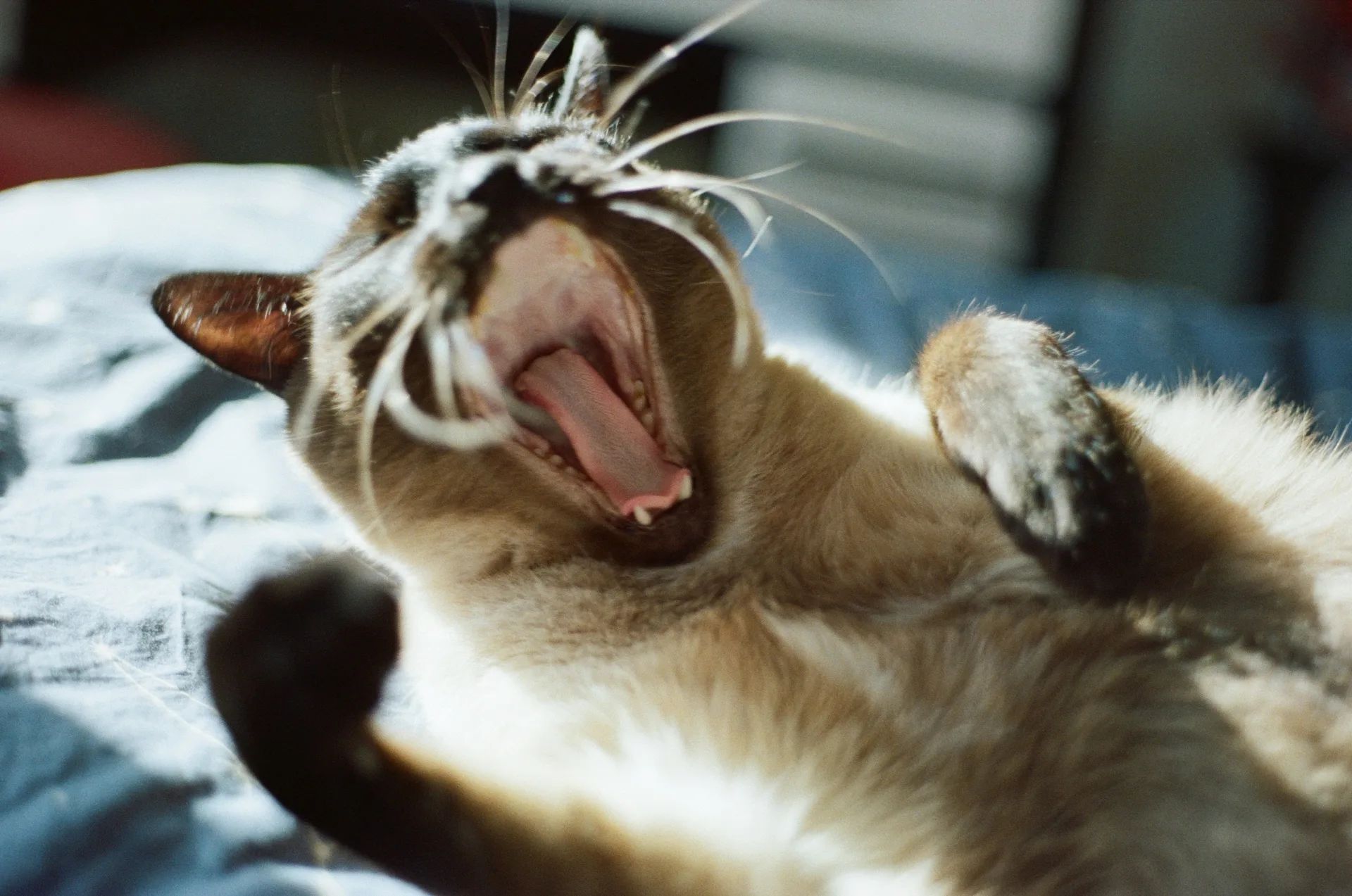
16Purrsonalities Team·April 4, 2026·8 min read
Why Is My Cat So Talkative? The Science of the Meow
Adult cats don't meow at each other — they invented it for us. Here's the science behind why your cat is so vocal, and what they're actually trying to say.
Your cat doesn't meow at other cats.
That's not a figure of speech. Adult feral cats — cats living outdoors, hunting their own food, mostly avoiding humans — barely meow at all. They hiss, trill, chirp, and growl. The meow is largely a kitten behavior, and most cats drop it by adulthood.
Except for the cats living in our homes, who have held onto it and aimed it almost exclusively at us. The meow that wakes you up at 5:47am, the one that follows you from room to room, the one deployed the exact moment you sit down with something hot to drink — that is a vocalization cats appear to have developed specifically to communicate with humans.
Which raises a genuinely strange question: did your cat invent a language for you?
The science of cat vocalization has been quietly accumulating for decades, and the answer it keeps arriving at is something like: kind of, yes.
Cats basically invented meowing for us
The clearest evidence comes from a 2011 study published in Behavioural Processes comparing how feral and house cats vocalized in response to human interaction across five social contexts. Feral cats — minimally socialized with humans — mostly produced defensive sounds when people were nearby: hissing, growling, spitting. House cats produced meows across all five contexts, with higher fundamental frequency than anything the feral cats generated.
The house cats weren't just meowing more. Their meows sounded different — higher-pitched, more melodically varied, more like the kind of sound that gets a human's attention.
A 2025 paper in Scientific Reports pushed this further by comparing domestic cat meows to those of five wild cat species, including the African wildcat, the domestic cat's closest wild ancestor. Domestic cat meows showed far more acoustic variability than any of the wild species. The interpretation: living alongside unpredictable humans — who respond inconsistently to the same sound — selected for vocal flexibility. The cats that could modulate their meows got better results, and those traits passed on.
A comprehensive 2020 review of feline vocal communication in the Journal of Veterinary Science put it plainly: adult cat meowing is "a rare vocalization in cat-cat interactions but one of the most common in cat-human interactions," and the house cat has "actually specialized their meow to communicate with humans and not with conspecifics." The cats that communicated effectively with humans got fed. They stayed warmer. They survived.
Your cat isn't making noise at you randomly. They're running a communication strategy that has been refining itself for thousands of years.
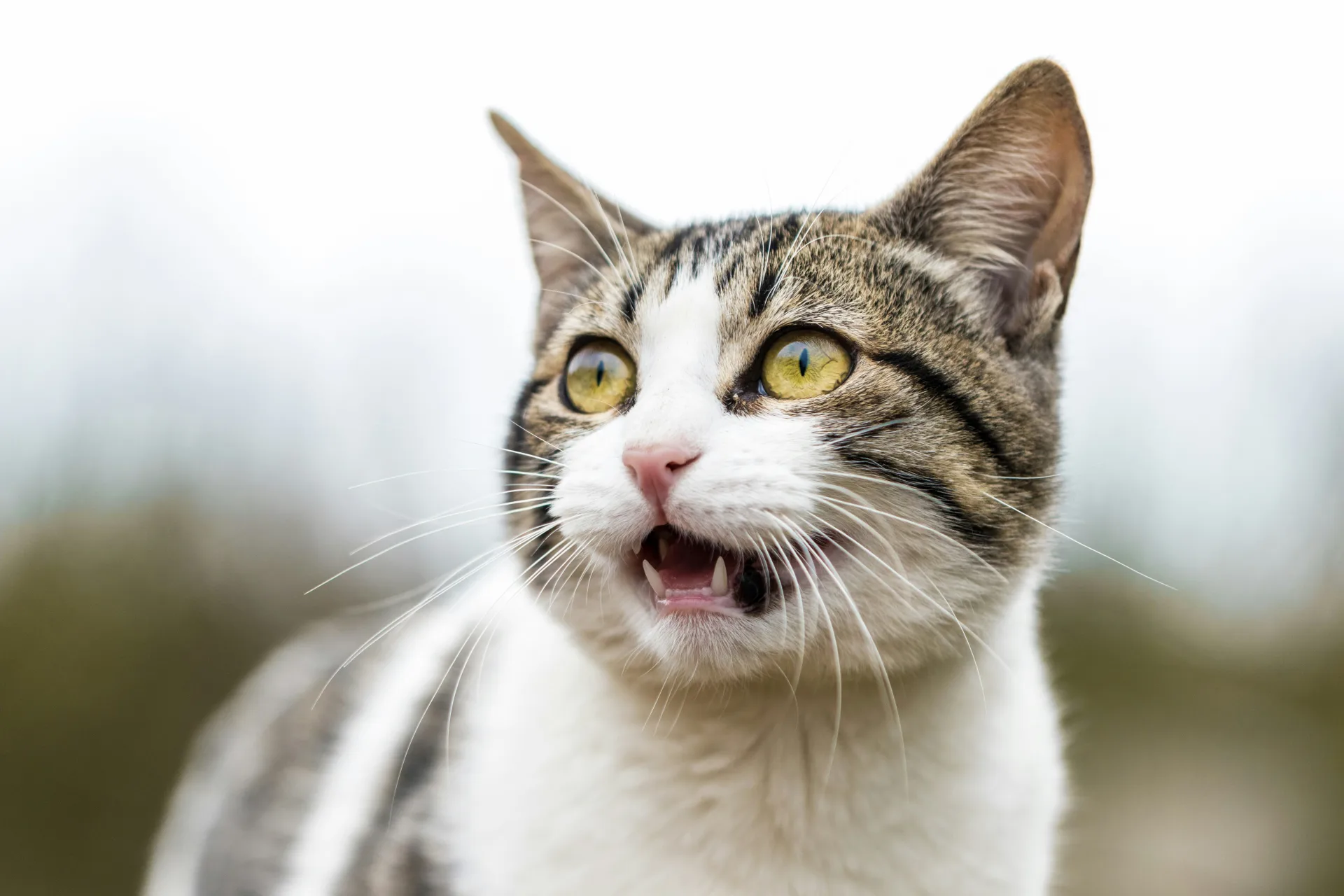
The purr that hides a cry
In 2009, researchers at the University of Sussex published a study in Current Biology about a specific type of purr that cats produce when they want something — usually food. They called it the solicitation purr.
On the surface, it sounds like an ordinary purr. Embedded within it, though, is a high-frequency acoustic component that sits right around the frequency range of a human infant crying. Researchers played solicitation purrs and regular purrs to human listeners — some cat owners, some not. Everyone found the solicitation purr more urgent. More grating. Harder to ignore.
The solicitation purr activated the same "respond now" circuitry that infant cries activate. Not because cats are consciously imitating babies — they aren't — but because that frequency range works on humans regardless of the source. Cats that produced it got responses. Over enough generations, the trait amplified.
Cat owners in the study were slightly better at identifying the urgency, but non-owners responded too. You don't need to be a cat person to feel it working on you.
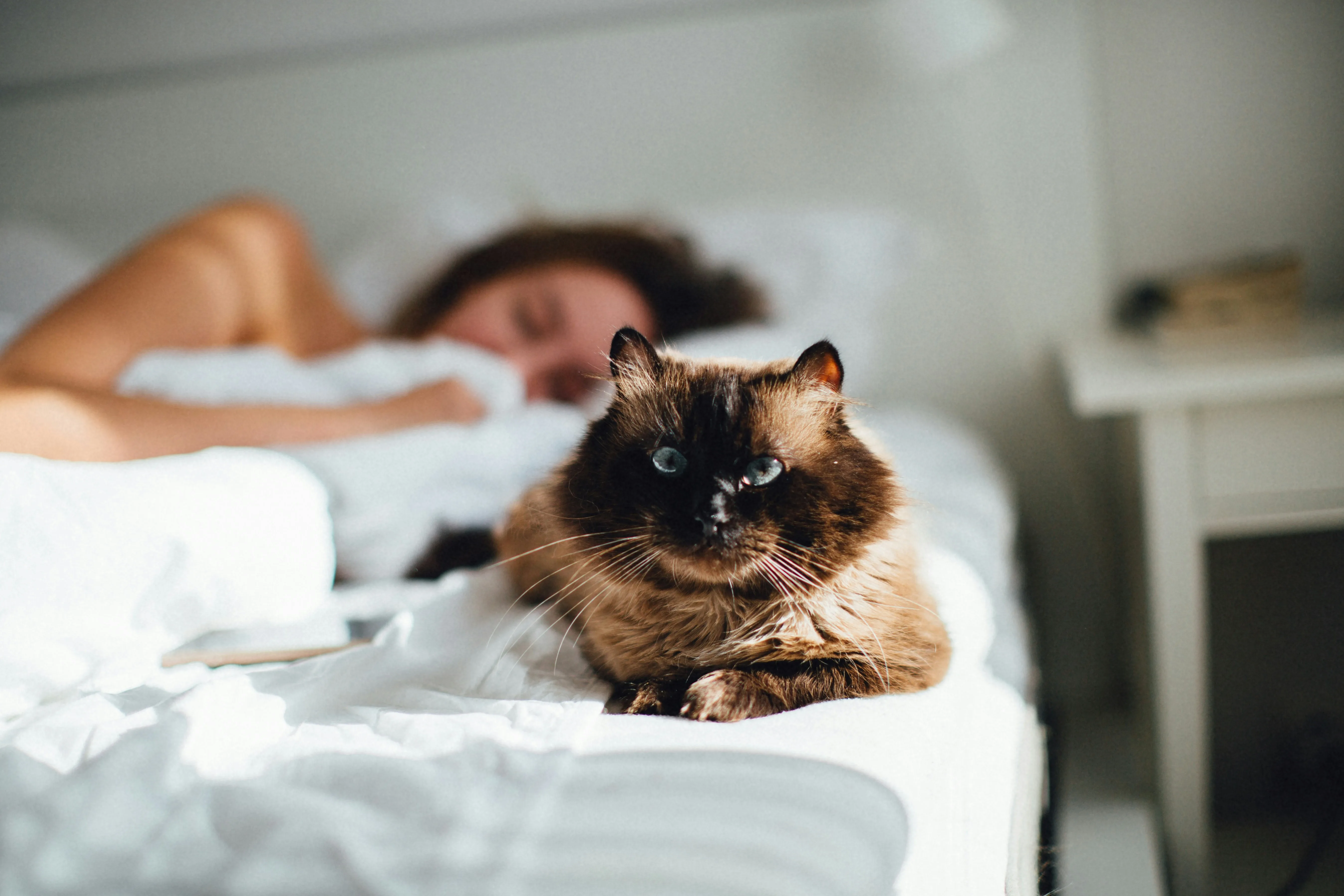
Your cat is speaking in context (you're just bad at listening)
The meow isn't one thing. A 2024 study in Applied Animal Behaviour Science recorded nearly a thousand meows from 40 cats across seven different contexts: cuddle time, food anticipation, play, greeting, wanting to go through a door, being lifted, and being put in a carrier. Context made a measurable acoustic difference.
Meows in aversive situations — particularly the carrier — had falling intonation, trailing downward in pitch. Meows in positive contexts like food anticipation and greetings showed rising or level intonation patterns. Older cats meowed at lower pitch than younger ones; females at higher pitch than males. The cats were encoding information in how they said things, not just that they were saying something.
Here's the catch: humans are not good at reading it.
A 2020 study in Animals had people listen to cat meows and try to identify the context. Overall accuracy was below 50%. Waiting for food was the most recognizable — 40% got it right. Distress and isolation sounds were harder. Female participants and cat owners did better, and people who scored higher on empathy toward cats were noticeably more accurate on distress signals.
A 2003 study in the Journal of Comparative Psychology concluded that meows function less as referential signals (this word means this thing) and more as "nonspecific, somewhat negatively toned stimuli that attract human attention." The meow's power is that it gets you to stop and pay attention. Precision is secondary.
Your cat is saying something. Whether you're reading it correctly is another matter.
Some cats are just louder — and personality is part of it
Breed plays a real role in how vocal a cat is. Siamese and Oriental cats are well-documented outliers — higher-pitched, more persistent, and generally more likely to maintain a running commentary on your daily decisions. Burmese and Balinese cats are also consistently cited as high-frequency vocalizers. Most researchers believe this is genetic, though the exact mechanisms haven't been fully mapped.
Beyond breed, personality matters too. The Feline Five study — a 2017 survey of 2,802 cats — found that "vocal" loaded modestly on the Extraversion factor during initial trait analysis, though it was ultimately dropped before the final factor model. The relationship is suggestive, not confirmed in that dataset. But the broader pattern holds: cats that score high on Extraversion tend to be active, curious, and socially engaged — a profile that overlaps considerably with being talkative.
Within the 16 Purrsonalities framework, the types we'd expect to be chattiest are the extraverted, socially-motivated ones. The Prince — warm, relational, deeply invested in household dynamics — and The Ham, who genuinely needs an audience, are probably at the top. The Clown and The Rebel bring the same energy in a more chaotic direction: constant commentary, strong opinions about the food bowl situation, narrating the full journey from window to couch to your lap.
On the quieter end: The Scientist, The Shadow, and The Wizard are all introverted and self-contained. They communicate, but on their terms, and usually with more economy. If your cat watches everything silently from across the room and speaks only when it matters, you might be living with one of these.
Not sure which type your cat is? The 16 Purrsonalities quiz takes about three minutes.
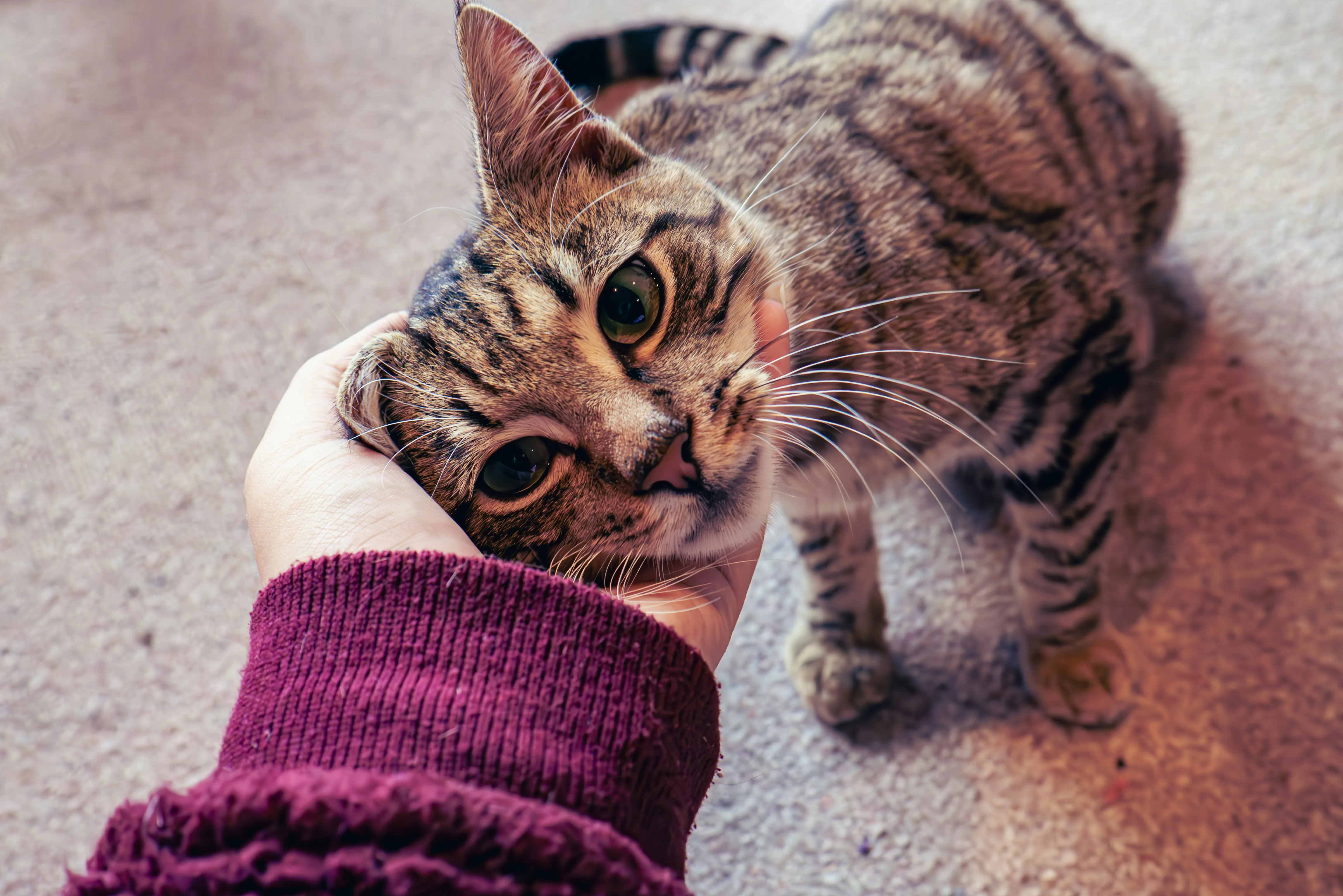
What your talkative cat is actually trying to tell you
The most useful thing to distinguish is whether your cat has always been vocal, or recently became more vocal. A cat who has chatted at you since kittenhood and continues to do so is just talkative. That's their personality. That's their communication style in action.
A cat who suddenly starts meowing more than usual is telling you something specific. The most common explanations:
- Hunger or a routine disruption — a schedule change, a food bowl that ran out earlier than expected
- Attention-seeking or loneliness, especially in single-cat households with long hours alone
- Wanting access to a space — door-directed meowing often gets misread as general distress
- Boredom or under-stimulation, particularly relevant for higher-Extraversion types
Medical causes are worth knowing, especially for older cats. Hyperthyroidism is one of the most common causes of sudden-onset vocalization in senior cats — the thyroid overproducing hormones produces restlessness and constant noise among other symptoms. Cognitive dysfunction — a feline version of dementia — can also produce increased or disoriented-sounding vocalization, often at night. If an older cat starts meowing more, especially in the dark, that's worth a vet visit.
For most cats, most of the time, more meowing just means more communication. A talkative cat is usually an engaged cat. They're talking because talking, over a very long time, has worked.
Your cat has been running a communication experiment on you — and so have thousands of generations of cats before them. The meow as we know it is a tool domestic cats appear to have refined specifically for human ears: higher-pitched than their wild relatives, more acoustically variable, tuned to frequencies that reliably get our attention.
You're not imagining the conversation. It's just that understanding it takes some work on your end.
If you want to go deeper into what makes your cat tick — not just how they communicate, but why — the science of cat personality is genuinely interesting and holds up better than most people expect. And if you want to know which of the 16 types you're actually living with, the quiz is free and takes three minutes.
Keep reading
8 min read · May 2026
Are Cats Introverts or Extroverts? Science Has a Real Answer
The introvert/extrovert instinct you have about your cat is probably right. Here's what 40 years of feline personality research says — and one key way it works differently than it does for humans.
9 min read · May 2026
Cat Personality Types: The 5 You'll Actually Recognize
Researchers identified five core personality dimensions in cats — and once you know them, you'll spot your own immediately. Here's what each one looks like to live with.
8 min read · Apr 2026
The Science Behind Cat Personality Tests (And Why It Actually Holds Up)
Cat personality tests seem like internet fluff — but a study of 2,802 cats and a peer-reviewed experiment using infant psychology says otherwise. Here's what the science actually found.
16Purrsonalities
Find out which of the 16 Purrsonalities your cat actually is
The quiz draws on the same personality dimensions the science validates. Takes 3 minutes.
Take the Free Quiz →